Dolphins

Chris Isidore
| 02-03-2026
 · Animal Team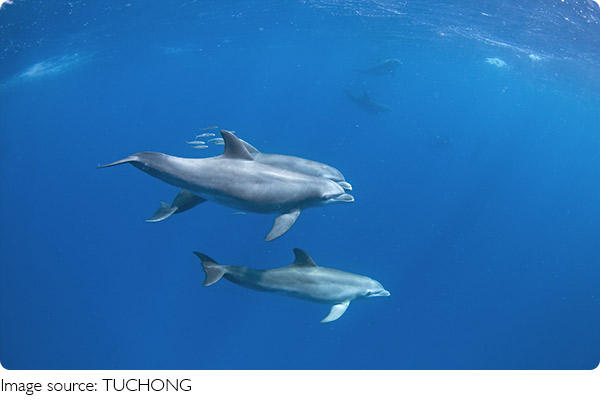
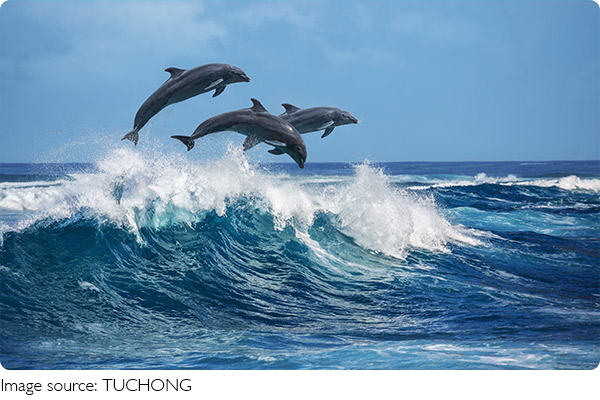
Watching dolphins leap gracefully above the waves, it's easy to be captivated by their intelligence and playful nature.
Yet beneath the surface, they rely on a remarkable natural ability—sonar, or echolocation—to explore the ocean, locate prey, and interact with each other.
This sophisticated biological system gives dolphins a sensory world far beyond human perception.
Understanding Echolocation
1. How sonar works
Dolphins emit a series of clicks and listen to the echoes that bounce back from objects around them. By interpreting the timing and intensity of these returning sounds, they can determine the size, shape, distance, and even texture of objects in their environment.
2. Specialized anatomy
The dolphin's melon, a fatty structure on its forehead, focuses and projects sound waves. Sounds reflected back are received by the lower jaw, which transmits vibrations to the inner ear. This anatomical setup allows dolphins to “see” with sound in murky waters where vision is limited.
3. Precision hunting
Using echolocation, dolphins can locate fish hidden under sand or in dense schools. Some species even coordinate in groups, using clicks and whistles to herd fish into compact areas for efficient hunting.
Communication Through Sound
1. Signature whistles
Each dolphin develops a unique whistle that functions like a name. These vocalizations allow individuals to identify each other, maintain group cohesion, and call for assistance when separated.
2. Social echolocation
Beyond hunting, echolocation helps dolphins navigate crowded environments and avoid obstacles. Pods use subtle changes in clicks and pulses to communicate directional cues and alert others to potential threats.
3. Adaptation to environments
Dolphins in different habitats fine-tune their echolocation. Coastal dolphins may use higher-frequency clicks for precision in shallow waters, while deep-water species rely on lower-frequency sounds that travel farther.
Scientific Insights and Human Applications
1. Studying dolphin sonar
Marine biologists use hydrophones to record and analyze dolphin clicks. Research on echolocation provides insight into dolphin intelligence, problem-solving, and social behavior, revealing a complex sensory world beneath the waves.
2. Inspiration for technology
Dolphin sonar has inspired human-made sonar and navigation systems used in submarines, underwater mapping, and medical imaging. Understanding their natural echolocation offers clues to improving these technologies.
3. Conservation implications
Noise pollution in oceans can interfere with dolphin echolocation. Studies highlight the importance of regulating marine traffic and industrial noise to protect these animals' primary means of sensing their environment.
Observing dolphins in the wild reminds us of the incredible ways nature equips animals to thrive in challenging environments. Echolocation not only demonstrates their remarkable intelligence but also underscores the delicate balance of marine ecosystems. Protecting their oceans ensures that these extraordinary navigators continue to leap, hunt, and communicate in the harmony of their watery world.